
The Hidden Frustration Behind Unpaid Debts and Broken Promises
I still remember the exact moment my stomach dropped. A freelance client completely stopped replying to my emails, walking away with thousands of dollars of my hard-earned money. I felt completely helpless and totally alone.
Every single day, I woke up angry and stressed out. I kept refreshing my bank account, hoping the money would magically appear. It did not.
I asked around for legal help, but the lawyers I called wanted more money upfront than the actual debt was worth. That was a massive wake-up call for me. I realized that if I wanted my money back, I had to take matters into my own hands.
Regular people face this exact same nightmare every single day. Maybe a landlord unfairly kept your security deposit. Perhaps a contractor ruined your kitchen and refused to fix the damage.
These situations steal your peace of mind and leave you feeling completely powerless. You lose sleep replaying the arguments in your head. You feel like the legal system is built only for the rich.
It is incredibly frustrating when someone wrongs you and you feel like you have no way to fight back. The anxiety of losing your money mixes with the anger of being disrespected.
But I am here to tell you something very important. You do not have to accept defeat just because you cannot afford an expensive legal team. The small claims court system was built specifically for regular people just like you and me.
You absolutely have the power to stand up for yourself. You just need to know the right steps to take.
Breaking Down the Legal Maze: Your Action Plan to Get Justice
Taking someone to court sounds like a terrifying process, but it is actually just a series of simple administrative steps. Once you break it down, the fear completely disappears.
We are going to walk through this entire journey together. I will show you exactly what to do, what to say, and how to present yourself like a total professional.
By the end of this guide, you will know exactly how to demand your money and take the right legal action. Let us dive into the actionable steps you can start taking today.
Sending a Strong and Professional Demand Letter
Before you ever fill out a single legal form, you need to ask for your money one last time. This is called a demand letter, and it is a massive requirement in most local courts.
A demand letter simply tells the other person exactly what they owe you and why. You also give them a strict deadline to pay before you officially file a lawsuit.
Keep your emotions completely out of this letter. Do not use angry words or threats. Just state the facts clearly and professionally.
Tell them the exact dollar amount they owe. Explain exactly how they can pay you, whether by check or online transfer. Give them a realistic deadline, usually about ten to fourteen days.
If they ignore the letter, you now have solid proof for the judge that you tried to solve the problem outside of court. Judges love seeing that you tried to be reasonable first.
Want to know the secret to writing a letter that actually gets responses? Watch this quick breakdown before moving on to the next step.
Figuring Out the Right Location to File Your Case
You cannot just walk into any random courthouse and hand them your paperwork. You have to file your case in the correct legal jurisdiction.
Usually, this means you must file in the county where the person you are suing actually lives. If you are suing a business, you file where the business is officially located.
Sometimes, you can file in the county where a contract was signed or where the accident happened. Always check your local county clerk website to confirm their specific rules.
Filing in the wrong county will cause your case to be thrown out immediately. That means you lose your filing fee and have to start all over again. Take the time to verify the correct address.
Becoming a Master at Gathering Evidence
Court is not about what you know. It is entirely about what you can successfully prove to a judge.
If you walk into a courtroom with just a story and no proof, you will likely lose. You need hard, undeniable evidence to back up every single claim you make.
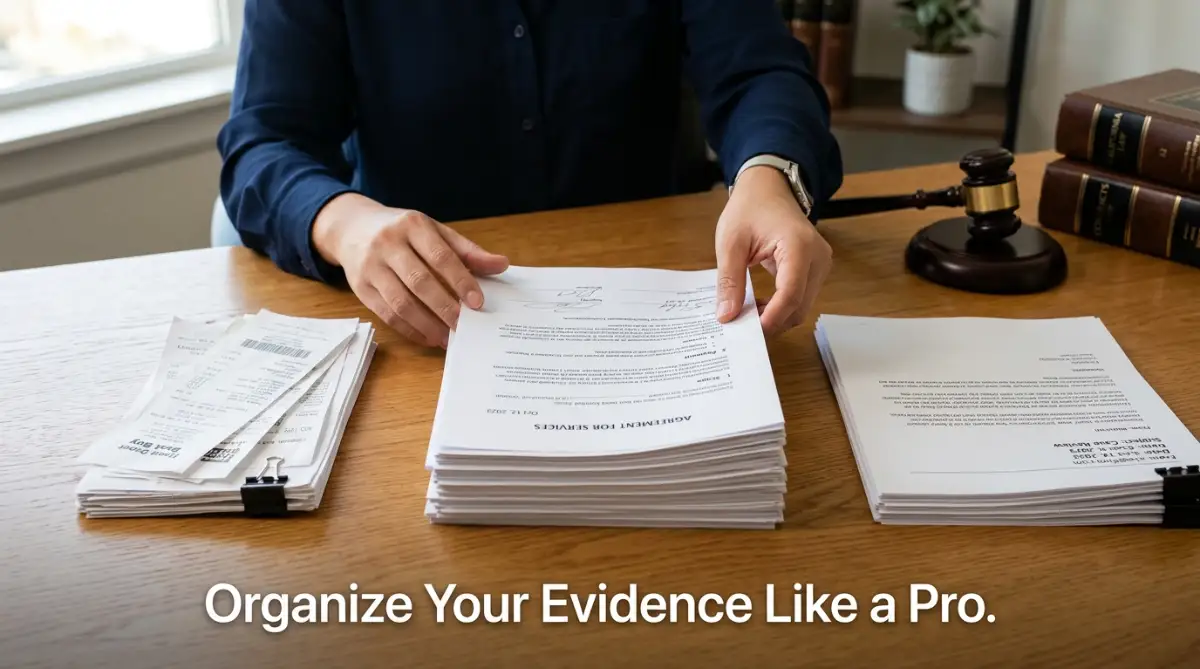
Start taking screenshots of every single text message and email related to your situation. Print them out so you have physical copies ready to hand over.
Gather your bank statements, canceled checks, and original signed contracts. If physical damage is involved, take bright, clear photographs from multiple angles.
I strongly recommend keeping a detailed timeline of events. Write down the dates of every phone call, meeting, and broken promise. This timeline will keep your thoughts incredibly organized when the judge asks you questions.
I learned the hard way that throwing loose papers into a folder is a terrible idea. I once dropped my entire stack of evidence right in front of a clerk, and it took me twenty minutes to put it back together in a panic. Always use a three-ring binder with clear plastic sleeves and sticky tabs so you can find any document in five seconds flat.
Finding Out Their True Legal Identity
You would be amazed at how many cases get dismissed simply because the person suing used the wrong name on the forms. Accuracy is your best friend here.
If you are suing an individual, you need their full legal name and their current physical home address. A P.O. Box will not work for court documents.
If you are suing a business, things get slightly more complicated. You cannot just sue "Joe's Plumbing" if their official legal name is "Joseph Smith Contracting LLC."
You must look up the business on your state's Secretary of State website. Find their official registered agent. This is the person legally designated to accept lawsuits on behalf of the company.
Writing down the wrong legal entity means even if you win, you will not be able to collect your money. Double-check every single letter of their name before you file.
Navigating the Complex Court Paperwork
Now comes the part everyone dreads the most: filling out the actual legal forms. It looks intimidating, but it is basically just a formal questionnaire.
Go to your local county court website and search for the small claims division. They will usually have a downloadable PDF packet you can fill out at home.
You will need to write down exactly how much money you are asking for. Be totally honest here. You cannot ask for a million dollars for emotional distress in a small claims setting.
You can only ask for the exact financial loss you suffered. If a mechanic ruined your car engine and it cost four thousand dollars to fix, you ask for exactly four thousand dollars.
Most courts charge a small filing fee, which usually ranges from thirty to one hundred dollars. Keep your receipt. If you win your case, the judge will often force the other person to pay you back for this fee.
The Art of Serving the Defendant Properly
Filing the paperwork at the clerk's office is only half the battle. Now, you have to officially notify the person that they are being sued.
This legal process is known as "serving the defendant." You absolutely cannot just hand the papers to them yourself. That is completely against the rules.
You have a few solid options to get this done legally. The easiest way is to send the paperwork via certified mail with a return receipt requested.
If they refuse to sign for the mail, you will need to hire a professional process server or pay your local sheriff's department. These professionals will physically track the person down and hand them the envelope.
Once they are served, the professional will give you a signed document called a Proof of Service. You must bring this piece of paper to court to prove the defendant knew about the trial.
Why Mediation Might Save You Time
Many small claims courts will not let you see a judge right away. First, they will make you sit down with a mediator.
A mediator is a neutral third party trained to help people compromise. They do not take sides, and they cannot force you to accept a bad deal.
Their only job is to see if both of you can reach an agreement without bothering the judge. Sometimes, just sitting in a formal room is enough to make the other person finally pay up.
If they offer you a fair compromise during mediation, strongly consider taking it. Getting guaranteed money today is often better than risking a total loss in front of a judge later.
If mediation fails entirely, do not panic. You simply tell the mediator you cannot reach a deal, and your case moves forward to an actual courtroom trial.
A Quick Reality Check on Court Myths
There are so many rumors about how court actually works. Let us clear up some major misconceptions right now.
Myth: The judge will yell at you if you make a mistake.
Reality: Small claims judges know you are not a lawyer. They are usually incredibly patient and will gently guide you through the process.
Myth: You will get your money the very same day you win.
Reality: Winning a judgment just means the court agrees they owe you. You still have to take separate steps to actually collect the money if they refuse to pay.
Myth: It takes years to get a court date.
Reality: Small claims cases move very quickly. You will usually get a trial date within one to three months of filing your paperwork.
Preparing Your Mindset for the Courtroom
Walking into a courthouse can make anyone feel nervous and sweaty. The best way to beat that anxiety is through intense preparation.
Practice what you are going to say in front of a mirror. Pretend a friend is the judge and have them ask you hard questions about your case.
Keep your opening statement under two minutes. The judge is incredibly busy and wants you to get straight to the facts immediately.
Never interrupt the judge, and never interrupt the person you are suing. When it is their turn to speak, just quietly take notes on a legal pad.
Dress as if you are going to a serious job interview. Wearing a clean suit or a conservative dress shows the court that you respect their time and authority.
How to Handle Counter-Suits Gracefully
Sometimes, when you sue someone, they get angry and decide to sue you right back. This is known as a countersuit.
Do not let this terrify you. It is a very common intimidation tactic used by bullies who want you to drop your case.
If they file a countersuit, simply prepare your defense the exact same way you prepared your offense. Gather evidence that proves their claims are completely false.
When you get to court, the judge will hear both cases at the exact same time. Just stay calm, present your proof, and let their lack of evidence speak for itself.
You have every right to stand your ground. Do not let aggressive paperwork scare you out of getting the justice you truly deserve.
Understanding the Limit of Small Claims
Every single area has a maximum dollar amount you are allowed to sue for. This is often called the small claims limit.
In some places, the maximum is five thousand dollars. In other locations, it might go up to ten or fifteen thousand dollars.
You need to know your local limit before you fill out your forms. If someone owes you twelve thousand dollars, but your local limit is ten thousand, you have a choice to make.
You can either drop your claim down to ten thousand to stay in small claims court, or you can hire an attorney to take the case to a higher civil court.
For most people, taking a small financial loss just to avoid paying heavy legal fees is the smartest and most stress-free decision they can make.
Keeping Your Expectations Completely Realistic
We need to talk about what happens after the gavel drops. Winning your case is an amazing feeling, but it is not the final step.
The court will hand you a piece of paper called a Judgment. This paper legally proves the debt is completely valid.
However, the court will not actively collect the money for you. You have to take that judgment and enforce it yourself.
If the person still refuses to pay, you might have to file more paperwork to garnish their wages. You could also put a legal lien on their house or property.
Knowing this reality upfront keeps you from feeling disappointed later. Small claims court is a powerful tool, but it requires your active participation from beginning to end.
Mastering the Courtroom: Advanced Strategies for a Guaranteed Advantage
Walking into a courtroom requires more than just a folder of receipts. If you want to absolutely dominate your case, you need to think like a seasoned legal expert.
The judge sees dozens of angry, disorganized people every single day. If you step up to the podium looking sharp and completely prepared, you already have a massive advantage.
Let us talk about some high-level secrets that most people never learn. These practical steps will help you stay calm, present your story clearly, and force the other side to take you seriously.
You do not need a law degree to use these tactics. You just need to be organized and pay attention to the smallest details.
The "Cheat Sheet" Method Judges Love
Judges are incredibly busy people with limited time for each hearing. They do not want to listen to a long, rambling story about how your feelings were hurt.
The secret to winning them over is creating a one-page summary of your entire lawsuit. Think of this as your personal cheat sheet.
At the very top of the page, bold the exact dollar amount you are asking for. Below that, write down three simple bullet points explaining exactly why you are owed this money.
Hand this summary to the judge along with your evidence packet. They will instantly appreciate your clear communication and respect for their time.
When the judge is happy and not confused, your chances of winning increase dramatically. Make their job as easy as humanly possible.
Building an Unbeatable Trial Binder
Do not walk into a courthouse holding a messy stack of loose papers. You need to build a professional trial binder that looks incredibly intimidating to the person you are suing.
Go to an office supply store and buy a thick, hardback binder with clear plastic sleeves. Create a completely separate section for text messages, a section for emails, and a section for financial records.
Make sure you bring three identical copies of this binder. One is for you to read from, one is to hand to the judge, and the final one goes to the person you are suing.
If your dispute involves an online contractor, you might need to gather digital files and communications. Knowing how to choose the most reliable file sharing tools for remote teams helps prevent these people from deleting shared evidence before your court date.
Always secure your digital proof the moment a disagreement starts. If the person you are suing had access to your private accounts, this is exactly why your family needs a shared password manager right now to lock them out immediately.
Mastering Your Physical Body Language
Your body language speaks much louder than your actual words in a quiet courtroom. If you look nervous or defensive, the judge might subconsciously doubt your story.
Stand up completely straight when you are talking to the judge. Keep your hands resting naturally on the podium, and do not cross your arms over your chest.
When the person you are suing starts telling lies, your natural reaction will be to shake your head or roll your eyes. You must force yourself to remain completely still and totally silent.
Instead of reacting with anger, simply write down their lie on a yellow notepad. When it is your turn to speak again, you can calmly explain to the judge exactly why their statement was false.
This level of emotional control shows the court that you are a highly reasonable person. The judge will naturally trust the person who remains calm under pressure.
Getting Clever with Uncooperative Witnesses
Sometimes, you need another person to back up your story. However, people are often terrified of going to a courthouse and getting involved in legal drama.
If a friendly witness refuses to show up, you are not totally out of luck. You can ask them to write down exactly what they saw and sign the paper in front of a public notary.
While a physical person in the courtroom is always the best option, a notarized letter is a powerful backup plan. It proves to the judge that you are not just making things up.
If this is a business dispute, bad security practices often lead to stolen data and messy lawsuits. You must stop sharing passwords on Slack and secure your small business today to prevent future legal headaches with uncooperative ex-employees.
The Most Dangerous Traps That Ruin Lawsuits
Even the most organized people can accidentally destroy their own case by making silly mistakes. The legal system is very strict, and there is almost zero room for error.
I want to warn you about the most common traps that catch regular people off guard. Falling into just one of these holes can get your entire lawsuit thrown out of the window.
If you know what these traps look like, you can easily walk right around them. Let us look at the biggest mistakes you absolutely must avoid.
Suing Someone Who Is Completely Broke
This is easily the most heartbreaking mistake people make. You can have a perfect case, brilliant evidence, and win your trial flawlessly.
But if the person you are suing has zero money in their bank account and no job, you will collect nothing. The court cannot magically pull money out of thin air.
Before you spend money on filing fees, you need to do some realistic research. Does this person have a steady income, a vehicle, or a house?
If they are completely bankrupt, spending months fighting them in court is a total waste of your valuable energy. Sometimes, walking away is the smartest financial decision you can make.
For more guidance on how collections actually work, I highly recommend reading through the debt collection rules established by the Consumer Financial Protection Bureau. It explains exactly what a court judgment can and cannot do.
Letting the Clock Run Out on Your Dispute
Every single legal conflict comes with a strict expiration date. This rule dictates exactly how long you have to file a lawsuit after an incident happens.
If someone broke a contract three years ago, you might already be too late to sue them. Once that legal deadline passes, your right to demand money completely disappears forever.
Never wait around hoping the person will eventually do the right thing. If they have ignored your demand letter, you need to file your paperwork immediately.
If you are confused about your local deadlines, you can easily read up on understanding the statute of limitations to see how these timeframes are calculated. Do not let your laziness cost you a victory.
Asking for Ridiculous Financial Damages
When someone wrongs you, it is natural to feel incredibly angry and insulted. You might feel tempted to ask the judge for extra money just for the stress they caused you.
Do not do this under any circumstances. Small claims judges deal in hard, proven numbers, not emotional distress or hurt feelings.
If someone dented your car bumper, you can only sue for the exact cost of the repair shop invoice. You cannot add an extra thousand dollars for your "wasted weekend."
Sometimes people borrow money to fix the damage while waiting for their court date to arrive. If you do this, watch out for hidden personal loan fees that can cost you more than expected. You usually cannot force the defendant to pay your personal loan interest.
Keep your demands completely realistic and backed by actual receipts. When you ask for exactly what you lost, the judge will see you as an honest and fair person.
If you are struggling financially while waiting for your settlement, there are safer ways to survive. You might want to explore 5 easy ways to secure personal loans without using your assets to keep your head above water.
Acting Like a Television Lawyer
We have all seen dramatic legal shows where lawyers yell, point fingers, and pace around the courtroom. Doing this in real life will make the judge incredibly angry with you.
A real courtroom is a very quiet, formal, and structured environment. There are no surprise witnesses bursting through the doors at the last second.
You must remain polite, use a steady voice, and always address the judge properly as "Your Honor." Never argue with the judge, even if you completely disagree with what they are saying.
The stress of fighting for your money can easily ruin your mood and your sleep schedule. Dealing with a stressful lawsuit is one of the silent health killers hiding in your modern lifestyle.
Keep your emotions in check, present your facts, and leave the drama for the movies. A calm demeanor is your ultimate superpower in front of any judge.
Ignoring the Importance of the Pre-Trial Mediation
Many people walk into a courthouse thinking they are just going to yell at the person who wronged them. They get very upset when they are forced to sit down with a mediator first.
Do not treat mediation like a waste of time. This is actually a golden opportunity to get guaranteed money in your pocket today.
Going in front of a judge is always a gamble, no matter how good your evidence looks. If the other person offers you eighty percent of what they owe during mediation, take it seriously.
Leaving with a guaranteed check in your hand is always better than risking a total loss. Check out these expert insights on self-representation in civil disputes to understand why settling early is often the smartest move.
Your Action Plan for Getting Paid and Moving On
You have now learned exactly how the system works and how to protect yourself. The mystery of the courtroom is completely gone, and you are holding all the right tools.
You no longer have to feel helpless when someone tries to steal your hard-earned money. You know how to gather your proof, file the right forms, and speak confidently in front of a judge.
Every big legal battle starts with just one small step. You do not have to do everything today, but you do need to start building your case right now.
To help you get started without wasting money, you should always compare your options carefully. Reading a smart personal loan comparison can save thousands with these pro tips if you need to manage your finances while fighting a long battle.
Before you go to the courthouse, always review the official small claims guidelines provided by the American Bar Association to ensure you are fully prepared for your local rules.
I know how terrifying it feels to stand up for yourself when the odds seem stacked against you. But I also know the incredible relief and pride you will feel when the judge finally bangs that gavel in your favor. My personal advice is to just take a deep breath, trust your evidence, and never let anyone bully you into silence.
Plain English Answers to Your Biggest Questions
Do I have to go to a physical court, or can I do this online?
Since the recent global shifts, many local courts now allow you to attend your hearing through a video call like Zoom. However, this entirely depends on your specific county rules. Always call your local court clerk to ask if a virtual hearing is an option for your case.
What happens if the person I sue completely ignores the court date?
If they do not show up, you just experienced the best-case scenario. The judge will listen to your side of the story and usually grant you a "Default Judgment." This means you automatically win the case simply because the other person failed to appear.
Can I bring my friends or family members to support me?
Yes, small claims court is completely open to the general public. You can absolutely bring a friend or a family member for emotional support. Just make sure they sit quietly in the back rows and do not interrupt the judge while you are speaking.
How long does a judge actually take to make a final decision?
Sometimes the judge will tell you their decision right there in the courtroom before you leave. Other times, they will want to review your evidence privately and mail you their decision a few days later. Do not panic if they do not give you an answer immediately.
Does losing a small claims case ruin the other person's credit score?
If they lose the case and immediately pay you the money, their credit score is usually totally fine. However, if they refuse to pay the court-ordered judgment, that debt can absolutely be reported to the credit bureaus. This will severely damage their credit score until they finally pay you what you are owed.
Disclaimer: The information provided in this article is for educational and informational purposes only and does not constitute official legal or financial advice. Court rules vary heavily by state and county. Always consult with a licensed attorney or legal professional in your specific jurisdiction before making any major legal decisions or filing official court documents