
The Shocking Reality of Unopened Mail
I vividly remember tossing a thick, white envelope onto my kitchen counter after a long day at work. My mind was exhausted, so I just ignored the paperwork completely, assuming it was standard junk mail. I thought my auto coverage would just roll over automatically without any issues.
A month later, my bank account was charged a ridiculous amount for my car protection plan. I called customer service in a complete panic, only to hear that my auto renewal went through with a massive rate increase. My heart sank right into my stomach, and I felt completely helpless.
I realized then that my blind trust had cost me hundreds of dollars. That single moment of ignoring my mail became a heavy financial burden that messed up my entire monthly budget.
This happens to everyday people all the time, completely destroying their peace of mind. Families are already struggling to balance grocery bills, utility payments, and daily expenses. When a sudden, unexplained price hike hits your bank account, it causes intense emotional stress and panic.
You feel cheated because you trusted the company to look out for your best interests. Instead, you are left scrambling to cover a payment that you never even planned for. The frustration of dealing with confusing legal terms and hidden fees makes you feel incredibly small.
People lose sleep worrying about how they will afford to keep driving to work safely. The mental toll of financial surprises is heavy, and it completely ruins your sense of stability.
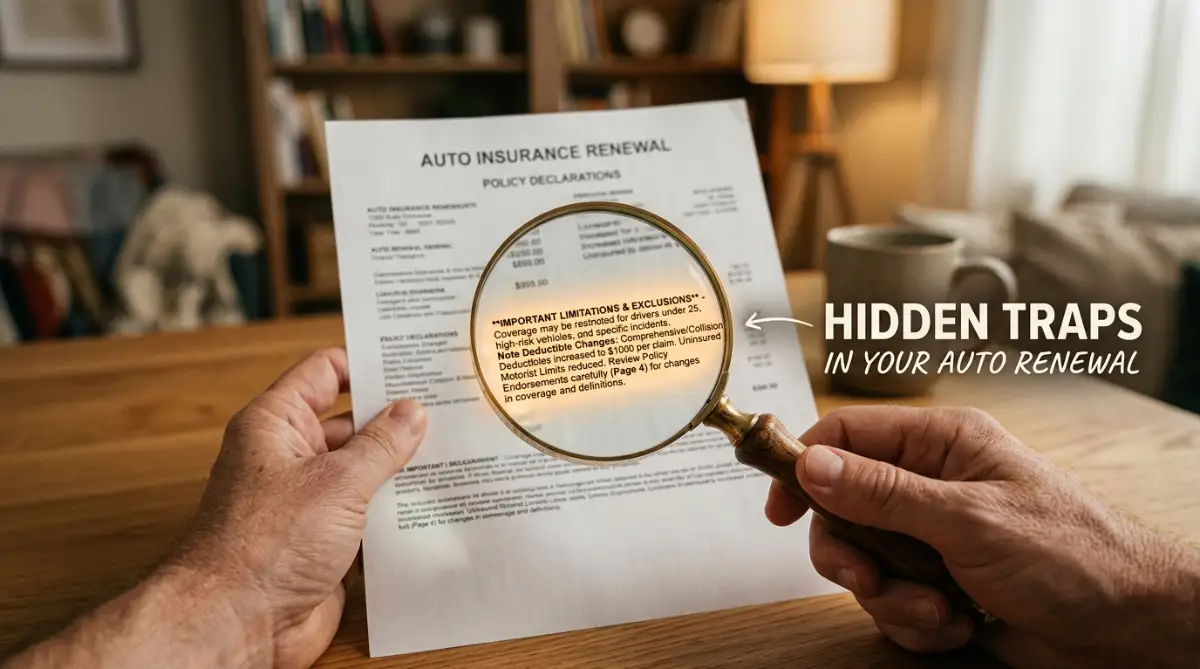
Decoding the Auto Protection Trap
Most people treat their insurance papers like a foreign language they never want to learn. We glance at the final price, maybe sigh in frustration, and then just pay it.
But this "do nothing" approach is exactly how large companies maximize their profits every single season. We need to explore exactly what hides inside those confusing pages before you lose another dollar.
By making a few smart observations, you can easily turn the tables and protect your wallet. Let us walk through some incredibly practical ways to review your paperwork like a seasoned expert.
Spotting the Sneaky Premium Shifts
The very first thing you need to check is your base premium rate compared to your last statement. Companies often increase this base rate slightly, hoping you will not notice a small jump.
They bank on human laziness, assuming you would rather pay an extra twenty dollars than shop around. Over time, these tiny adjustments compound into a massive financial drain on your family.
Always keep your old statement handy when the new one arrives in your mailbox. Place them side by side on your table and physically trace the numbers with a pen. If the base price increased without any accidents on your record, you need to ask questions.
Understanding Your Declarations Page
The declarations page is the absolute most important sheet of paper in that thick envelope. It summarizes exactly who is covered, what vehicles are protected, and what your specific limits are.
Many policyholders make the terrible error of skipping this page entirely because it looks like a math test. However, this is exactly where hidden coverage drops and sneaky limit changes usually hide.
Here is a great resource to help you understand this better:
Watch this quick breakdown to see exactly how experts read a declarations page so you never get tricked by confusing terms again.
The Danger of Dropped Discounts
When you first signed up, the agent likely threw in every possible discount to win your business. You probably got paperless discounts, safe driver rewards, or even new customer bonuses.
What they do not tell you is that some of these discounts automatically expire after a set time. Suddenly, you are paying full price just because a promotional period quietly ended.
Here is a personal lesson I learned the hard way. I once assumed my "good student" discount for my younger brother would stay on the account forever. I never called to update his graduation status, and the company quietly removed the discount, costing me an extra fifty dollars a month. Always call your agent to demand a full review of all available discounts before you pay.
The Myth of Unconditional Loyalty
There is a huge misconception that staying with the same company for ten years makes you a valued customer. We naturally believe that loyalty should be rewarded with the best possible pricing and perks.
Myth: The longer you stay with an insurance provider, the cheaper your premium becomes.
Reality: Companies actually use a practice called "price optimization," where they slowly raise rates on loyal customers who are unlikely to leave.
They offer all the best deals to brand-new customers to get them through the door. Meanwhile, you are subsidizing those cheap rates by paying a higher premium just because you hate changing companies.
You must make it a habit to check prices with at least three different providers every single time your current plan is up. Shopping around is the only proven way to keep your current provider honest and competitive.
Why Deductibles Magically Change
A deductible is the amount of money you promise to pay out of your own pocket before the company steps in. Sometimes, your provider might quietly raise your deductible from $500 to $1000 to keep your monthly bill looking low.
You might think you are getting a great deal on your monthly payment until you actually get into a fender bender. Suddenly, you realize you have to find a thousand dollars in cash just to get your bumper fixed.
Always verify that your comprehensive and collision deductibles have not been altered without your clear permission. If you do not have that amount sitting in an emergency savings account, you cannot afford that deductible.
Life Changes You Forgot to Mention
Your daily life probably changes a lot more than you realize over the span of a few months. Maybe you started working from home and now you barely drive your car to the office anymore.
If your daily commute dropped from twenty miles to zero, your risk of getting into a crash has massively decreased. But if you do not tell your provider about this lifestyle change, they will keep charging you for a high-risk commute.
Even simple things like getting married or moving to a safer neighborhood can dramatically lower your rates. Take a moment to list any major life events that happened recently and report them immediately.
The Depreciating Vehicle Dilemma
Cars lose their value extremely fast, especially during the first few years of ownership. You might be paying for premium collision coverage on a car that is barely worth three thousand dollars today.
If you completely total an older car, the payout you receive might be less than what you paid for the coverage itself. This is a very common financial mistake that drains money from hard-working people.
Check the current market value of your vehicle online using free pricing tools. If the cost of your comprehensive and collision coverage is more than ten percent of your car's total value, it might be time to drop it.
Avoiding the State Minimum Trap
When money is tight, you might be tempted to call your agent and ask for the absolute cheapest plan available. They will usually drop you down to the bare minimum liability limits required by your specific state laws.
This sounds like a smart budgeting move until you accidentally rear-end a luxury SUV on the highway. State minimums are notoriously low and will almost never cover the full medical and repair bills of a major accident.
Once your coverage limit is reached, the other driver's lawyers will come directly after your personal savings and assets. You must ensure your Bodily Injury and Property Damage limits are high enough to protect everything you own.
Ignoring the "Permissive Use" Clause
Have you ever let a friend or a family member borrow your car to run a quick errand? You probably assumed your coverage would automatically protect them if they got into a scrape.
Many modern policies are quietly changing their rules regarding drivers who are not explicitly named on the document. Some companies will significantly reduce the payout or deny the claim completely if an unlisted person was behind the wheel.
You need to read the specific section about permissive use very carefully. If your teenager just got their license, do not assume they are covered just because they live in your house.
Paying for Duplicate Perks
Insurance companies love to up-sell extra features like roadside assistance or rental car reimbursement. These add-ons sound incredibly helpful when an agent is pitching them to you over the phone.
However, you might already have these exact same benefits through a completely different service. Many premium credit cards or auto club memberships already provide free towing and lockout services.
Take a close look at your itemized bill and cross-check it with your credit card benefits or new car warranty. Stop paying twice for a service that you only plan to use once every few years.
The Credit Score Connection
Most people have no idea that their personal credit history directly impacts how much they pay to drive. In many places, companies will run a soft check on your credit file before they generate your new offer.
If your score recently took a hit because of high credit card balances, your driving premium might suddenly spike. They use these hidden algorithms to predict how likely you are to file a claim in the future.
On the bright side, if you recently paid off a big loan and improved your score, you deserve a better rate. You should actively remind your agent that your financial health has improved and demand a fresh quote.
How Gap Coverage Becomes Useless
If you financed a brand-new vehicle, the dealership probably strongly suggested that you add gap protection. This special feature pays the difference between what your car is worth and what you still owe the bank if it gets totaled.
It is incredibly useful during the first couple of years when your loan balance is much higher than the car's value. But as you make steady monthly payments, that gap eventually closes completely.
Once your loan balance is lower than the actual cash value of the vehicle, you are just throwing money away. Check your current auto loan statement today and cancel this extra feature if you no longer need it.
Reviewing the Ride-Share Rules
The gig economy is booming, and you might have picked up a side hustle delivering food or driving passengers. It seems like a perfectly harmless way to make extra cash on the weekends.
But standard personal auto plans absolutely do not cover you while you are logged into a ride-share app. If you get into an accident while delivering a pizza, your provider will immediately deny the claim and likely drop you forever.
If you are using your personal car to make money, you must secure a specific commercial or ride-share endorsement. Do not risk complete financial ruin just to make a few extra bucks on a Friday night.
The Hidden Penalty of Auto-Pay
Setting up automatic payments feels like the ultimate smart move for a busy life. You never have to worry about missing a due date or paying silly late fees again.
But companies absolutely love auto-pay because it practically guarantees you will never review your billing statement. They know that if the money just disappears from your account silently, you will never question a price hike.
You should definitely keep auto-pay active for convenience, but set a strict reminder on your phone. Two weeks before the money is scheduled to leave your account, sit down and review every single line item carefully.
Checking the Named Insured Details
This sounds incredibly basic, but you would be shocked at how often paperwork has the wrong names listed. Sometimes an ex-spouse is still listed on the document, giving them unnecessary access and control.
Other times, a child who moved out years ago is still driving up your rates because they remain on your profile. Keeping inaccurate personal details on your official documents can lead to major legal headaches if a claim is filed.
Make sure the only people listed on your active paper are the ones who currently live with you and drive your vehicles. A simple five-minute phone call to remove an old driver can instantly save you a noticeable amount of cash
Taking Control: Pro Strategies for Smarter Auto Renewals
Once you understand the basic tricks hiding inside your paperwork, you can start playing offense. You do not have to sit back and just accept whatever price a massive corporation throws at you.
We can actually use their own complex systems against them to secure amazing rates. Let us explore some incredibly smart, expert-level strategies that most everyday drivers never even think about.
These are the exact same tactics that financial advisors use to keep their own monthly bills incredibly low. By implementing just a few of these ideas, you will completely change how you handle your household budget.
The Magic of Telematics and Driving Apps
Have you ever noticed those little tracking devices or mobile apps your provider constantly begs you to download? They promise to give you a massive discount if you just let them monitor your daily driving habits.
Many people immediately reject this idea because they feel uncomfortable sharing their personal location data. However, if you are a genuinely safe driver who rarely speeds, this technology can save you hundreds of dollars.
These programs track how hard you hit the brakes, how fast you accelerate, and what time of day you travel. If you work from home or only drive to the local grocery store, you are the perfect candidate for these savings.
Before you sign up, you should read independent reviews about usage-based driving programs to understand exactly how your data is handled. Once you know the rules of the game, you can easily prove that you are a low-risk driver who deserves a cheaper bill.
Leveraging Defensive Driving Certifications
Most of us have not taken a formal driving class since we were teenagers trying to get our first license. We completely forget that continuing education is one of the easiest ways to slash our monthly premiums.
Many providers offer a massive percentage off your total bill if you simply complete an approved defensive driving course. These classes can usually be done entirely online from the comfort of your couch on a lazy Saturday afternoon.
The initial cost of the course is usually extremely cheap, but the discount applies to your account for several years. This small investment of your time will pay for itself almost immediately after your next billing cycle begins.
The Illusion of Automatic Bundling
Every single commercial on television tells you that bundling your home and auto protection will magically save you a fortune. Agents push this concept extremely hard because it locks you into their ecosystem and makes it harder for you to leave.
But sometimes, putting all your eggs in one basket is actually a terrible financial move. A company might offer you a fantastic deal on your house, but secretly charge you way above the market average for your cars.
You must take the time to price everything out separately just to see the real numbers. Much like uncovering hidden financial charges in other areas of life, you have to do the math yourself to spot the bad deals.
Do not blindly accept a bundle just because it feels convenient to have only one password to remember. Sometimes splitting your accounts between two different specialized providers will keep significantly more cash in your wallet.
Strategic Deductible Management
Most people pick a random deductible amount when they first buy their car and never look at it again. If you have an older vehicle but still carry a very low deductible, you are simply throwing your cash into a fire.
As your car gets older and loses its total value, you should actively raise your deductible to lower your monthly premium. If you have built up a solid emergency savings fund, carrying a higher deductible is a remarkably smart financial move.
You are basically betting on your own safe driving skills while keeping the monthly savings in your own bank account. This strategy allows you to build wealth over time instead of handing it over to a giant corporation every thirty days.
Scheduling an Annual Policy Audit
The absolute best habit you can build is treating your auto renewal just like your yearly physical at the doctor. You need to set a hard date on your calendar specifically dedicated to reviewing your driving paperwork.
Make yourself a cup of coffee, sit at your kitchen table, and pull up quotes from at least three competing companies. You should treat this process as a personal challenge to find a better deal than the one you currently have.
When you actively practice comparing smart financial products every single year, you remove the emotion from the process. You start seeing your provider as a service you hire, rather than an unchangeable part of your life.

Dangerous Blunders That Will Drain Your Savings
It is incredibly easy to make a small error that ends up costing you everything during a major crisis. People usually only discover these massive mistakes right after they get into an accident, which is the absolute worst time to find out.
When a claims adjuster sits across from you and coldly explains that your specific situation is not covered, the feeling is devastating. The sheer panic of realizing you have to pay tens of thousands of dollars out of your own pocket is completely paralyzing.
Let us walk through some common nightmares so you can make absolutely sure they never happen to your family.
The Silent Danger of Undeclared Drivers
Imagine your younger sister moves into your spare bedroom while she searches for a new apartment. She occasionally borrows your sedan to run errands or drive to job interviews.
You probably think nothing of it because she is a careful driver with a completely clean record. However, almost every single company strictly requires you to list all licensed drivers living under your roof.
If she causes a major wreck and the company finds out she lives with you but was not on the paperwork, they will completely deny the claim. This is a terrifying form of soft fraud, and it happens every single day to well-meaning families. Always update your resident list immediately to avoid total financial ruin.
Ignoring the Actual Cash Value Drop
Many drivers mistakenly believe that if their vehicle is totaled, the company will write them a check to buy a brand-new replacement. This is a completely heartbreaking myth that leaves people stranded without a ride to work.
Standard policies only pay out the "Actual Cash Value" of your vehicle the exact second before the crash happened. If you drive a five-year-old car, they are only going to give you enough money to buy another used five-year-old car.
People get incredibly angry when they receive a tiny check that barely covers a down payment on a new vehicle. You must understand exactly how your car is valued today so you can manage your expectations and plan your finances accordingly.
The Autopay Complacency Trap
Setting your monthly bills on autopilot is extremely convenient, but it makes you completely blind to creeping price hikes. When money silently leaves your checking account, you lose your emotional connection to how much you are actually spending.
Providers are fully aware of this psychological trick, and they slowly inch your premium up by a few dollars every single cycle. They know you will never bother to log in and cancel an automatic draft over a tiny five-dollar increase.
If you want to protect your budget, you need to learn about managing automatic payment schedules properly. Keep the auto-pay turned on, but force yourself to read the final PDF statement before the money is actually withdrawn.
Slashing Limits to Save Pennies
When inflation hits hard and groceries become expensive, many folks look for the fastest way to cut their monthly spending. The easiest target is usually their car protection plan, so they call their agent to slash their coverage limits.
Dropping down to the absolute bare minimum liability limits feels like a huge win until you accidentally hit a brand-new sports car. State minimums barely cover a fraction of the cost of modern vehicle repairs and extended hospital stays.
Once your tiny coverage limit is exhausted, the opposing lawyers will aggressively target your personal savings, your home equity, and your future wages. The idea of protecting your hard-earned personal assets should always be your top priority. Saving twenty bucks a month is never worth risking everything you have built over your lifetime.
Falling for the Loyalty Penalty
As I mentioned earlier, assuming your long-term provider is giving you the best deal is a massive mistake. People form strange emotional attachments to their insurance brands because of funny commercials or a friendly local agent.
But behind closed doors, these corporations regularly use unfair price optimization tactics on their most loyal customers. They specifically target people who renew without asking questions, slowly squeezing more profit out of them every year.
You must treat your coverage like a strict business transaction, devoid of any emotional loyalty. If a competing brand offers the exact same protection for a lower price, you need to pack your bags and switch immediately.
Misunderstanding Medical Payments
Depending on where you live, you might have optional medical payments coverage attached to your auto paperwork. This feature is designed to cover immediate hospital bills for you and your passengers after a wreck, regardless of who was at fault.
Many people decline this protection because they assume their regular health coverage will handle everything. But much like the similar traps found in medical coverage paperwork, regular health plans often have massive deductibles of their own.
Having a small amount of auto medical coverage can instantly pay for those scary ambulance rides or emergency room visits without draining your savings. Do a quick comparison between your health plan deductibles and your auto options to make the smartest choice for your family.
Your Ultimate Action Plan for Financial Peace
Taking charge of your household paperwork does not have to be a stressful or miserable experience. Once you know exactly what numbers to look for, the entire process becomes incredibly simple and empowering.
You hold all the power as a consumer, and you should never let a confusing legal document intimidate you. Companies rely on your confusion to make a profit, so educating yourself is the ultimate form of self-defense.
Here is a simple, highly effective checklist you can use the very next time a thick renewal envelope arrives in your mail:
- Do Not Ignore the Envelope: Open it the very same day it arrives and immediately compare the total premium to your last statement.
- Verify Your Life Details: Check the listed garaging address, the daily commute mileage, and the names of every authorized driver.
- Analyze the Deductible: Make sure nobody quietly raised your out-of-pocket costs without asking for your clear permission first.
- Hunt for Competitors: Hop on the internet and gather at least three fresh quotes from highly rated companies in your area.
- Check Official Rules: Always cross-reference your choices with the official state guidelines for auto coverage to ensure you remain fully compliant.
When you follow these straightforward steps, you create a powerful barrier around your bank account. You will never again wake up to a shocking price increase or a devastating denied claim.
Instead, you will enjoy the quiet confidence of knowing exactly what you are paying for and why. This level of organization is the absolute foundation of locking in secure financial stability for your entire family.
I know how overwhelming adult responsibilities can feel when you are already tired from a long week of working. But taking just thirty minutes today to read through your auto documents will give you an incredible sense of relief. My own financial anxiety completely disappeared the moment I stopped hiding from my paperwork and finally took control.
Frequently Asked Questions About Auto Paperwork
Why did my monthly premium suddenly go up when I have a perfectly clean driving record?
Even if you never crash or get a speeding ticket, your rates can still increase based on the area you live in. If there is a massive spike in local car thefts, severe weather damage, or expensive medical costs in your city, the provider will raise everyone's rates to cover their potential losses. Your credit score dropping can also trigger a surprise price hike.
Should I just stick with the same company for a long time to get loyalty perks?
Honestly, extreme loyalty usually works against you in this specific industry. Providers love to slowly increase rates on customers who never bother to shop around for better deals. You should make it a strict habit to check prices with outside competitors every single year just to keep your current company honest.
Is it a safe financial move to just carry my state's bare minimum coverage limits?
No, it is extremely dangerous to only carry the minimum limits required by your local government. State limits are usually incredibly low and will barely cover a fraction of the cost if you total a modern luxury vehicle. If you cause a severe accident, you will be personally sued for the remaining balance, which can instantly wipe out your life savings.
How far in advance should I start hunting for new rates before my current plan expires?
You should absolutely start looking around at least three to four weeks before your current paperwork officially expires. This gives you plenty of time to compare different offers, ask questions, and smoothly transition to a new brand without any annoying lapses in your coverage.
Does it actually matter if I let my adult child stay on my policy after they move out?
Yes, it matters a lot because the address where the vehicle is parked every single night determines the overall risk level. If they move to a busy downtown area with high crime, but you tell the company they still live in your quiet suburb, that is considered soft fraud. The company can easily deny a massive claim if they find out the car was secretly moved to a new location.
Disclaimer: The information provided in this article is strictly for general educational and informational purposes only and does not constitute professional financial or legal advice. Insurance regulations and policies vary heavily by location and individual circumstances. Please consult with a licensed professional or agent before making any major changes to your personal coverage plans.